


Border Conflict Ceasefire Agreed; Return of Cambodian Soldiers After 72 Hours
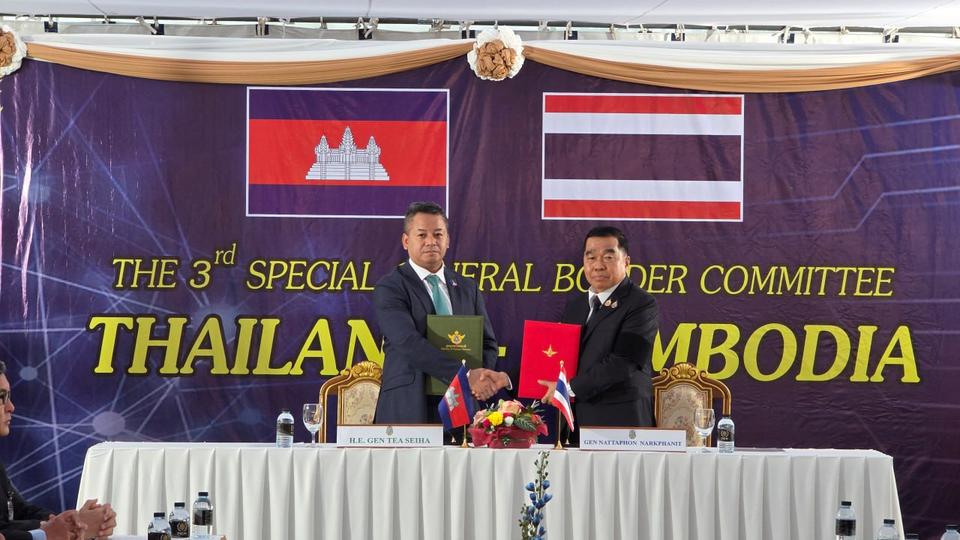
Both Cambodia and Thailand agreed to a ceasefire at the special General Border Committee (GBC), with the return of soldiers expected after 72 hours, and displaced people to their homes at the border.
A 16-point agreement with immediate ceasefire starting 12pm today (December 27) has been agreed by Cambodia and Thailand, along with the release of 18 captured Cambodian soldiers if both parties strictly observe the truce for 72 hours, as heavy fighting on the ground took place early this morning. The soldiers have been held captive by Thailand for 151 days since the last conflict in July.
However, National Defence Minister Tea Seiha and Thai Defence Minister Nattaphon Narkphanit, who signed on the deal at the special General Border Committee (GBC), said current troop deployments would be maintained, though further movement will not be made, including patrol towards the other party’s areas.
“There will be some calm with the ceasefire for 72 hours,” Seiha said during a press conference after the end of the GBC meeting.
No air strikes, unprovoked firing
Both sides agreed not to increase troops, noting that any reinforcement would heighten tensions and negatively affect long-term efforts to resolve the situation.
They agreed not to undertake provocative actions that may escalate tensions. “This includes military activities to enter the other side’s air space and territory or positions as of ceasefire. Both sides agree to refrain from constructing or enhancing any military infrastructure or fortifications beyond their own side,” they said.
The ceasefire involves a halt on all types of weapons, including attacks on civilians, civilian objects and infrastructures, and military objectives of either side, in all cases and all areas.
The ceasefire also entails no provocative actions that may escalate tensions, including military activities to enter the other side’s air space and territory or positions.
“Both sides must avoid unprovoked firing or advancement or movement of troops towards the other side’s positions or troops. This agreement must not be violated under any circumstances,” the parties agreed.
Border demarcation continues
Civilians from the affected areas will be allowed to return to their homes at the earliest opportunity without obstruction and in a safe and dignified manner to resume their lives and livelihoods.
In addition, they said, the arrangements under this Joint Statement are “without
prejudice” to the border demarcation and international boundary between the two countries, with both agreeing to resume the Joint Boundary Commission (JBC).
“Survey and demarcation works in accordance with existing agreements between the two countries will continue to ensure lasting peace along the border, using existing JBC mechanisms to ensure safety and security of the joint survey team on the ground, including its safety from landmines,” they added.
Additionally, they will refrain from constructing or enhancing any military infrastructure
or fortifications beyond their own side.
Prevention of transnational crimes
The border conflict, which began on December 7, believed to be sparked by landmine explosions that injured several patrolling Thai soldiers along the border, has killed 30 Cambodians civilians and injured 88 people. Over in Thailand, 26 soldiers and 41 civilians have died due to the conflict. Over one million people on both sides have been displaced from their homes as a result.
Efforts to reach a ceasefire and for parties to return to the Kuala Lumpur Joint Declaration had been repeatedly made by the US, China and ASEAN, with calls by governments and protests to end the conflict around the world.
The US and China, especially made telephone calls and shuttle-diplomacies, respectively to get the parties to end the conflict and return to the joint peace agreement.
Despite this, fighting continued with Thailand deploying F-16s and T-50 jets to drop bombs along with ground troops launching artillery shells and mortar rounds against civilian areas, damaging schools, bridges, government buildings, casinos and homes.
Thailand earlier said that the conflict also targetted scam centres with the aim of extinguishing its operations.
Among the points in the special GBC agreement, parties consented to adhering to an action plan to prevent and suppress transnational crime, including cyber scams and human trafficking.
AOT to monitor
Both sides also agreed to work together through the joint coordinating task force on humanitarian demining the standard operating procedures to ensure timely progress on demining efforts along the border.
The ASEAN Observer Team (AOT) will be allowed to continue monitoring the implementation of the special GBC agreement. They also agreed to ensure effective implementation by using their Border Coordination Units to ensure that the ceasefire is sustained, manage situations on the ground, address incidents in a timely manner, and prevent miscalculation under the observation and verification of the AOT.
