



PM Warns Against “Weaponizing” Scam Fight to Target Countries
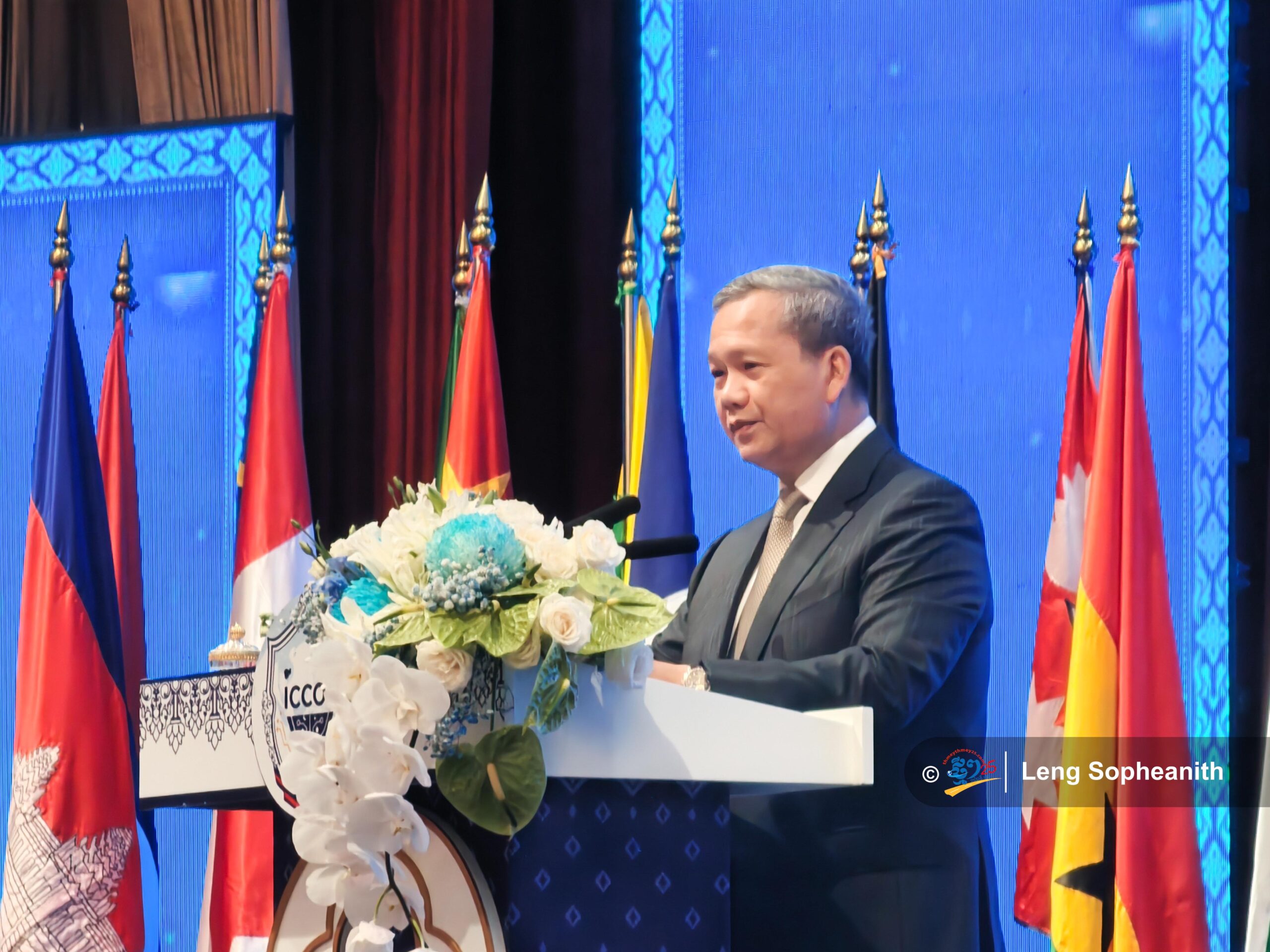
PHNOM PENH – Prime Minister Hun Manet says technological fraud must not be weaponized against other nations or used to attack sovereign territory. He has pledged to confront these complex challenges as Cambodia hosts an online scams conference.
In his opening remarks, Hun Manet said Cambodia has suffered from this phenomenon, as it has affected areas along the border with Thailand. He said anti-scam objectives should never be used to justify land occupation.
During the border skirmish, Thailand bombed several casinos and hotel complexes in a border region in Cambodia, where it claimed the areas were used as scam centers involved with human trafficking.
Thailand believed Cambodia used the complexes as a military base, which Cambodia dismissed.
The Thai military occupied the complexes, notably the O’Smach complex in Oddar Meachey province where they showed reporters around the place.
“On the contrary, anti-online scam efforts should be the reason for nations to work together with sincerity and mutual respect to tackle the issue for common benefit,” he said during the International Conference on Combating Online Scams (ICCOS) on September 23.
He said every country must educate and safeguard its citizens, taking measures to prevent the people from being deceived by overseas employment and financial scam trends.
Addressing the participants, Hun Manet said international financial institutions, technology platforms, encrypted communication networks, and cryptocurrency platforms must prevent illicit proceeds by imposing strict verification protocols.
“No single country can effectively tackle this cross-border challenge alone,” he said.
“The scam online industry did not begin in Cambodia and is not at least confined to Cambodia. Cambodia’s early exposure was due to the growth of online gambling and similar related businesses.”
International Call for Continuous Cooperation
The top leaders have repeatedly said that technological fraud has become sophisticated and evolved with top-notch technological advances, requiring all nations to work together to tackle this global issue.
Delphine Schantz, regional representative of the United Nations Office on Drugs and Crime, said online scams and fraud impact individuals across society, leading to losses ranging from small amounts to entire life savings. These crimes undermine economic activity and erode trust in institutions.
In the latest Transnational Organized Crime Threat Assessment for Southeast Asia, she said scam losses in East Asia, Southeast Asia, Australia and New Zealand are now estimated to amount to up to $114 billion per year, which is growing rapidly.
“Criminals have always used new technologies to their advantage, and crime has always adapted to avoid law enforcement,” Schantz said.
“This will require continued commitment from the top leadership and across the criminal justice chain and beyond that.
“It will also require continued readiness to work together and to deepen cooperation.”
Yang Weilin, Chinese Vice Minister of Public Security, said the world is confronted with rare multiple risks and challenges, with traditional and non-traditional security threats.
Strengthening international law enforcement and security cooperation has become a universal consensus across nations.
“The current international and regional security landscape remains severe and complex,” Yang said. “We must never politicize the fight against transnational crimes, let alone engage in stigmatization and bloc confrontation.”
Nicholas Court, director of the Taskforce Coordination Directorate, INTERPOL, said INTERPOL has noticed that the online scam industry has increased by more than 15 percent. This is why INTERPOL is proud to offer its services to the member countries to help them to combat the threat, he said.
Operation Haechi resulted in the recovery of $340 million and the freezing of 68,000 bank accounts, while Operation First Light led to 5,800 arrests and an additional recovery of $300 million by member countries.
“This is not an abstract crime simply of large numbers,” he said. “It is a human crime with real human costs, and those costs are being borne every second of every day, in every country of the world.”
Cambodia is hosting the two-day ICCOS in Phnom Penh, where leaders from 27 countries come together to tackle online scams.
It is co-supported by the Lancang-Mekong Integrated Law Enforcement and Security Cooperation Center, the United Nations Office on Drugs and Crime Regional Office for Southeast Asia and the Pacific, and INTERPOL.
Source: https://cambodianess.com/article/pm-warns-against-weaponizing-scam-fight-to-target-countries