



How a Cambodian craft distillery makes the world’s best gin (VIDEO)
In the premium spirits market, the crown is usually worn by European distilleries.
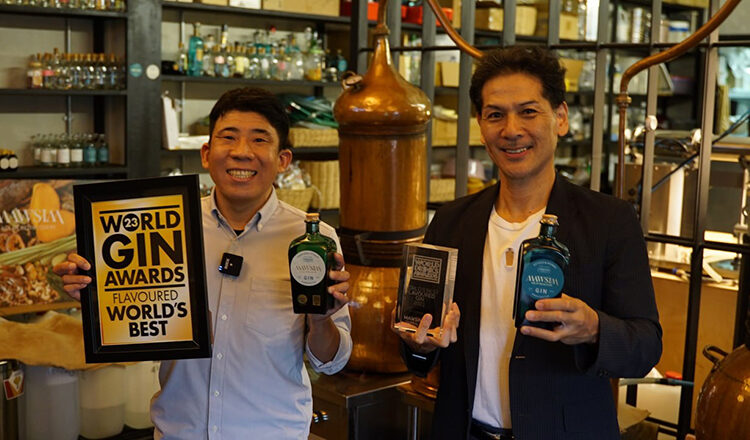
But in 2023, the international spirits community was stunned when a craft gin from Cambodia took home the top prize at the World Gin Awards in the United Kingdom, winning the World’s Best Flavoured Award.
“This gin is an exotic Cambodian botanical,” said Ryuji Nukata, Japanese chief distiller and head bartender of Mawsim gin. “This is made in Cambodia with Cambodian ingredients and won the World Best Gin. So, a world champion from Cambodia.”
Mawsim’s rise from a boutique venture to a global heavyweight has been swift. The distillery originally launched two distinct flavours in 2022.
By 2023, the founders decided to enter their creations into the prestigious World Gin Awards, an event that Nukata recognised as “kind of like a gin Olympics, gin World Cup.”
The scale of the competition was massive, but the Cambodian contender immediately made waves.
“In 2023, among the more than 1,100 gin entries, we are so proud to tell you that the tropical citrus and spice and herbs, both flavours, were the gold winners,” Nukata said. “So two flavours advanced to the tournaments, and we were surprised when our tropical citrus fruity gin also won the tournament. So, this was the best gin in the world in 2023. And we got the special crystal trophy from the UK.”
The victory marked a milestone not just for Cambodia, but for the entire continent.
“As you know, now in Japan, there are a lot of nice gins,” Nukata said. “We’re from Japan, but even Japanese gin never won one of the best before 2023. Korea, Singapore, never. So, we’re the first-ever world best winner in Asia. So proud of the Cambodian ingredients.”
The winning streak has continued. Mawsim recently introduced a high-proof variation, and the accolades multiplied.
“We created a new flavour, the Mawsim Gin Spices & Herbs Depth 57,” Nukata said. “This won gold in 2026. We’re so proud of our Cambodian ingredients.”
While Mawsim is celebrated today as a world-class brand, its origins have nothing to do with alcohol or nightlife. Instead, the company was born out of a Japanese recycling initiative trying to solve an environmental crisis in Cambodia’s waterways.
Kenji Tsuzaki, CEO and master distiller of Mawsim Distillery, provided the unexpected backstory. Originally from Tokyo, Tsuzaki arrived in Phnom Penh during the COVID-19 pandemic.
“Actually, we didn’t come to Cambodia to make gin,” Tsuzaki said. “We came to Cambodia to find a solution for the environmental problem; however, we started making gin in 2021.”
Back in Japan, Tsuzaki’s background was rooted in sustainability.
“We are a recycling company in Japan,” he said. “We collect waste paper from the house and the company and sell it to the paper manufacturing company. The amount of waste paper has been decreasing in Japan. That’s why we try to find a way to use waste paper in another way. Then, we try to see if we could make ethanol from the waste paper. Then, after many experiments in Japan, we successfully developed a method to make ethanol. But there is a strict regulation in Japan. So, we cannot make ethanol in Japan. That’s why we try to find another opportunity outside Japan.
That’s why we came to Cambodia.”
Upon arriving in Cambodia, the team shifted its focus from waste paper to a pressing local ecological threat: the suffocating overgrowth of water hyacinths in the country’s rivers.
“We discovered another environmental problem in Cambodia. That’s water hyacinths,” Tsuzaki said. “Technology to make ethanol from waste paper is very similar to technology making ethanol from water hyacinths.”
However, translating environmental science into a financially viable operation proved difficult.
“Most challenging is the cost,” Tsuzaki said. “Many processes are required. To keep that kind of project financially stable, we thought we could do something different. We were looking to see if ethanol could be used as part of the gin. That’s how Mawsim Gin was born.”
For Nukata, the move to Cambodia was a personal transformation that began well before the distillery was conceived.
“I’ve been in Cambodia more than 14 years,” Nukata said. “Cambodia is the first country out of Japan. I love Cambodia, so.”
When the distillery concept took shape, the team committed entirely to celebrating the agricultural abundance of its adopted home. The country’s tropical climate offered a stark contrast to the seasonal limitations of Japan.
Mawsim Gin uses local fruits, spices and herbs available in Cambodia, including organic fresh mango, passion fruit, Battambang orange, lime, kaffir lime, calamansi, traditional lime, fresh pepper, red dry pepper, ginger, galangal, black cardamom, coriander seeds, cashew, fever tree and lemongrass.
To find these ingredients, the distillers routinely venture into Cambodia’s rugged terrain.
“Sometimes, we go to the mountain area to try to get a nice wild galangal, wild turmeric, and bring it back here for distillation,” Nukata said.
As Mawsim expands its market footprint, the team is witnessing a shift in both international appreciation and local drinking culture.
“We are already exporting Mawsim gin to Japan, the Philippines, Singapore, Saigon (Ho Chi Minh City), and Shanghai. And there will be more. We try to be more international,” Nukata said.
Closer to home, the response has been equally rewarding, especially when local farmers see their harvest transformed into a world-winning spirit.
“Cambodian people are still learning how to appreciate gin. They like to drink beer or wine,” Nukata said. “The people at the pepper farm … we use their pepper, they smell the gin, they are surprised by the peppery flavour.”
Despite soaring global demand, Mawsim has no intention of abandoning the meticulous, small-scale craftsmanship that brought the brand to the world stage.
“The Mawsim cannot be mass produced,” Nukata said. “Of course, to make a business, mass production could be okay, but at Mawsim, we still focus on premium and limited recipes. That’s how we get the unique flavours.”