

PM Set to Visit China to Strengthen Cooperation After Senate President’s Visit
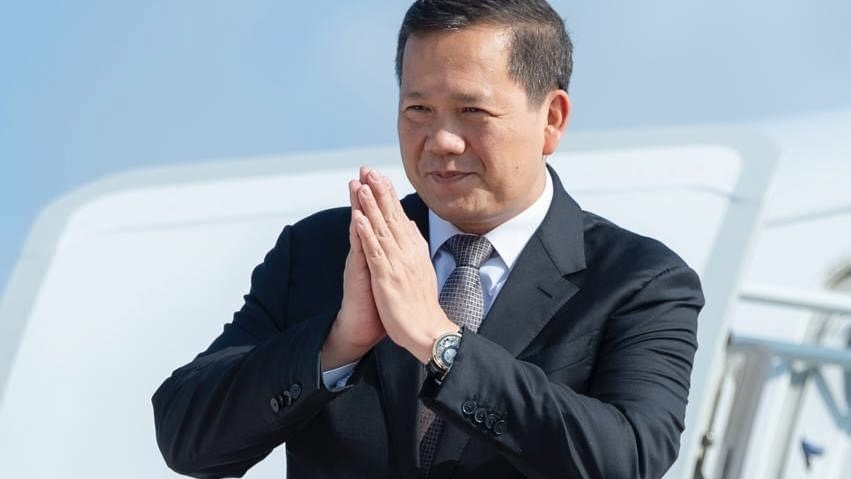
Prime Minister Hun Manet will visit China in mid-July to deepen bilateral cooperation, with analysts saying the trip underscores Cambodia’s increasingly close – and growing dependent – relationship with Beijing.
Prime Minister Hun Manet is gearing up to visit China in mid-July, following the recent visit of Senate President Hun Sen, to strengthen cooperation while turning the strategy into tangible results, with analysts noting that this visit reflects both a strong bond and a growing dependence.
According to spokesperson for the Prime Minister, Jean-François Tain, during Manet’s visit, he will focus on implementing the directions agreed upon in principle by the top leaders of both countries, Hun Sen and President Xi Jinping.
“During the upcoming visit to China, PM Hun Manet will meet with China’s Premier Li Qiang to discuss ways to strengthen cooperation between Cambodia and China in many sectors, including the economy, investment, trade, infrastructure, agriculture, technology and people-to-people exchanges,” he said.
Manet’s visit follows the goodwill visit by Hun Sen from June 25 to 27, where he met the Chinese President in Beijing on June 26 and requested continued Chinese financing for infrastructure projects in Cambodia, while China is willing to establish a security partnership with Cambodia.
Tain said that Hun Sen’s visit, as president of the Cambodian People’s Party (CPP), was important for strengthening ties between the CPP and the Chinese Communist Party.
“As Senate President, he has contributed to strengthening state-to-state relations and enhancing political trust between Cambodia and China,” he said, emphasising that Hun Sen’s visit and the upcoming visit by Manet are not repeat work but instead complement one another.
“One visit focuses on strengthening trust and strategic direction at the party and state levels, while the other focuses on turning those goals into tangible results,” he said.
According to Chea Thyrith, spokesperson of the CPP, Manet will attend the World Artificial Intelligence Conference. The World Artificial Intelligence Conference, held from July 17 to 20.
Him Rotha, Deputy Director at the Cambodian Centre for Regional Studies, believes that the recent high-level exchange between Cambodia and China reflects the “strong bond relationship” between the two countries, while noting the quote by Hun Sen, which suggests that “although the world has changed, weather has varied, Cambodia-China relations will never change”.
“Through this statement, we can see that Cambodia still values the importance of friendship with China and vice-versa though there have been some disappointments following recent developments,” he said, stressing that Manet’s visit will enhance business as usual with China.
Rotha noted that there is already a strong regular diplomatic engagement between both nations, but currently, there are more issues to discuss, including the development of the bilateral relationship and the wider regional affairs.
“One of the biggest elephants in the room for Cambodian foreign policy discourse these days is the conflict with Thailand. China has expressed its intention to mediate and facilitate,” he said, noting that there are also other issues to sort out, including issues related to transnational crimes, as well as regional cooperation within the ASEAN framework.
Seng Vanly, a Southeast Asia geopolitical analyst, noted that this flurry of high-level diplomatic movement makes it glaringly obvious that Cambodia’s escalating engagement with China is not merely about standard neighbourhood diplomacy, but rather a calculated strategy of government survival and systemic dependency.
While for economic perspective, he noted that this accelerated courtship highlights Cambodia’s profound structural dependence on Chinese state-backed capital to fuel its domestic developmental narrative, saying that the government depends on infrastructure megaprojects, deep-sea ports and massive industrial corridors.
However, he said that this heavy reliance on China also makes Cambodia vulnerable to pressure and debt risks. “The relentless alignment of Cambodia’s Pentagonal Strategy with China’s Belt and Road Initiative reveals a nation increasingly locked into a geopolitical trajectory where its economic survival is entirely contingent on Chinese goodwill,” he said.
In addition, he noted that the recent introduction of new foreign and defence 2+2 strategic dialogue mechanisms, alongside the securing of comprehensive security partnerships amidst regional border frictions, underscores the geopolitical trade-offs at play.
He said Cambodia effectively operates as Beijing’s most reliable proxy within ASEAN in exchange for infrastructure funding and a shield against Western criticism over its human rights record.
“Through a critical lens, this intensified diplomatic schedule is less about mutual cooperation and more about Cambodia locking itself into an asymmetrical dependency, trading long-term strategic autonomy for the short-term stability of its ruling elite,” Rotha said.