



Cambodia Adds 700 Large-Scale Factories as Industrial Workforce Tops 1.26M
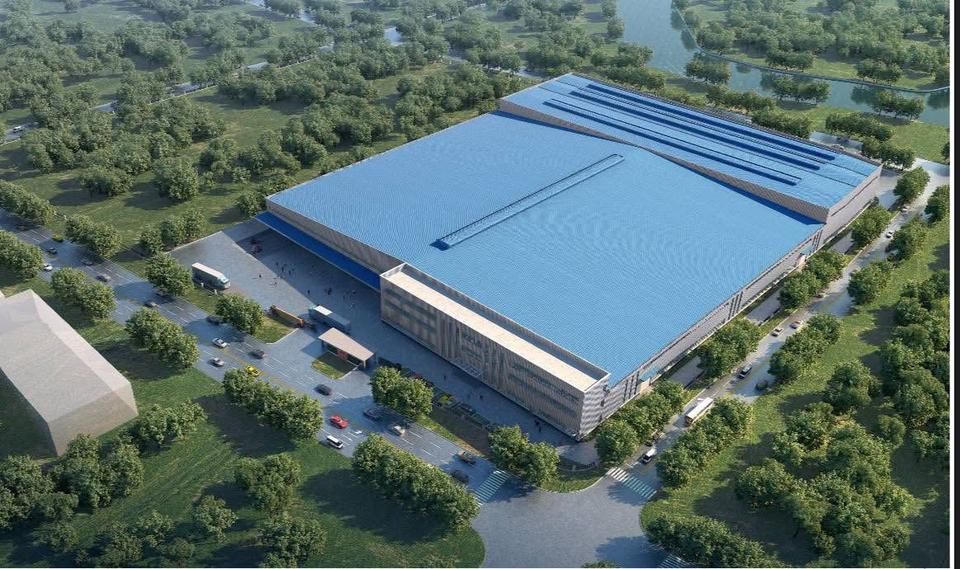
Cambodia’s industrial sector recorded strong growth in 2025, with 700 new large-scale factories established, the industrial workforce rising to 1.27 million and total investment exceeding $25.168 billion
Cambodia had 3,357 factories registered with the Ministry of Industry, Science, Technology and Innovation (MISTI) as of July 2026, with total investment exceeding $28 billion, official figures reveal.
The number of large-scale factories operating in the country also rose sharply in 2025, reaching 3,083 across all 25 capital cities and provinces — an increase of 658 factories, or 27.13 percent, compared with 2024.
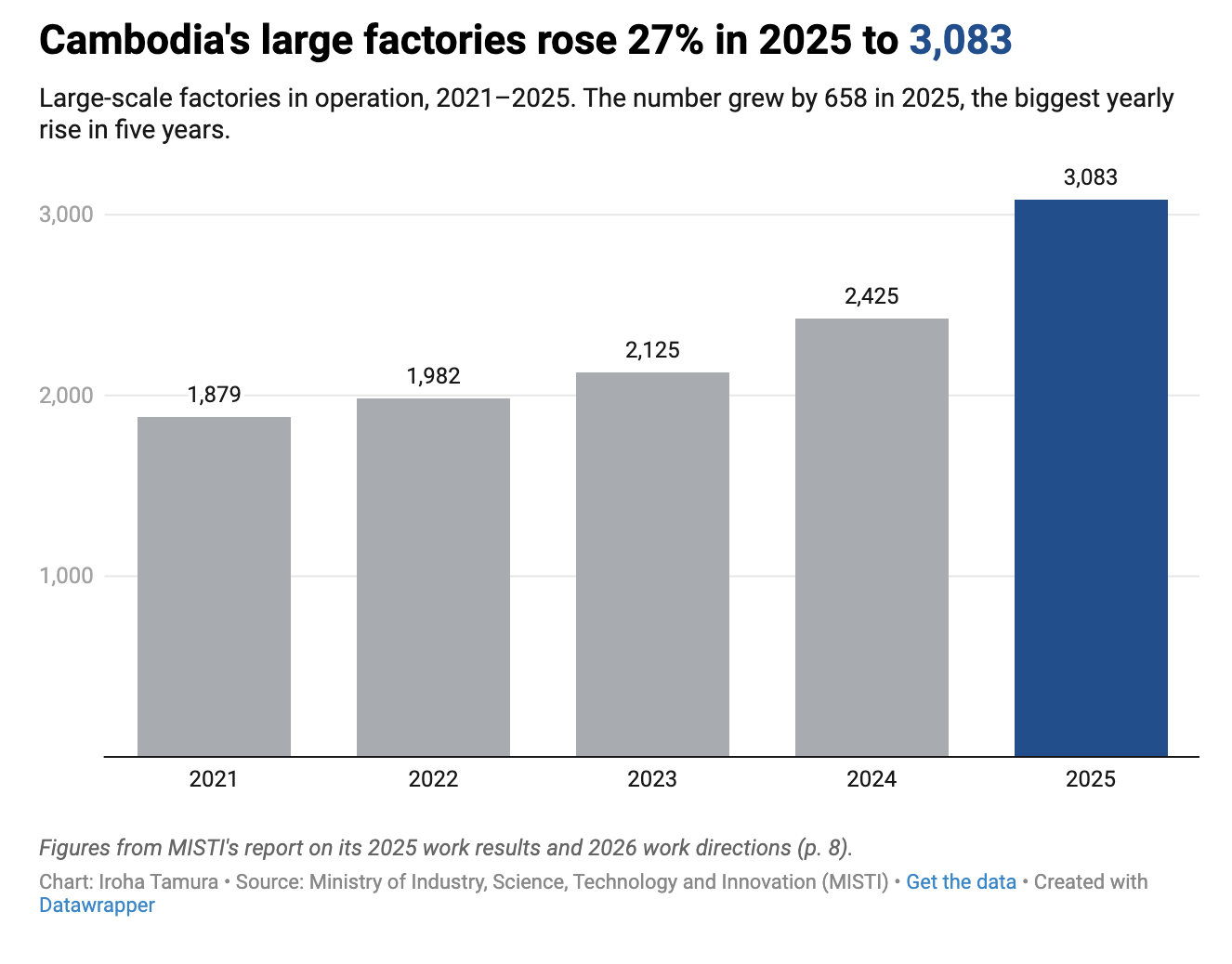
The figures were outlined in a ministry report detailing industrial development and the implementation of policies, strategies and legal frameworks during 2025.
The report said 700 new large-scale factories were established across 19 capital cities and provinces during the year, representing an increase of 374 factories, or 114.72 percent, compared with 2024.
Meanwhile, 42 large-scale factories closed across seven capital cities and provinces in 2025, up by 16 factories, or 61.54 percent, from the previous year.
The ministry attributed the growth to working mechanisms introduced in line with the Cambodia Industrial Development Policy 2015–2025 and the Pentagonal Strategy—Phase 1.
Industrial workforce expands
The expansion of the factory sector was accompanied by an increase in the industrial workforce.
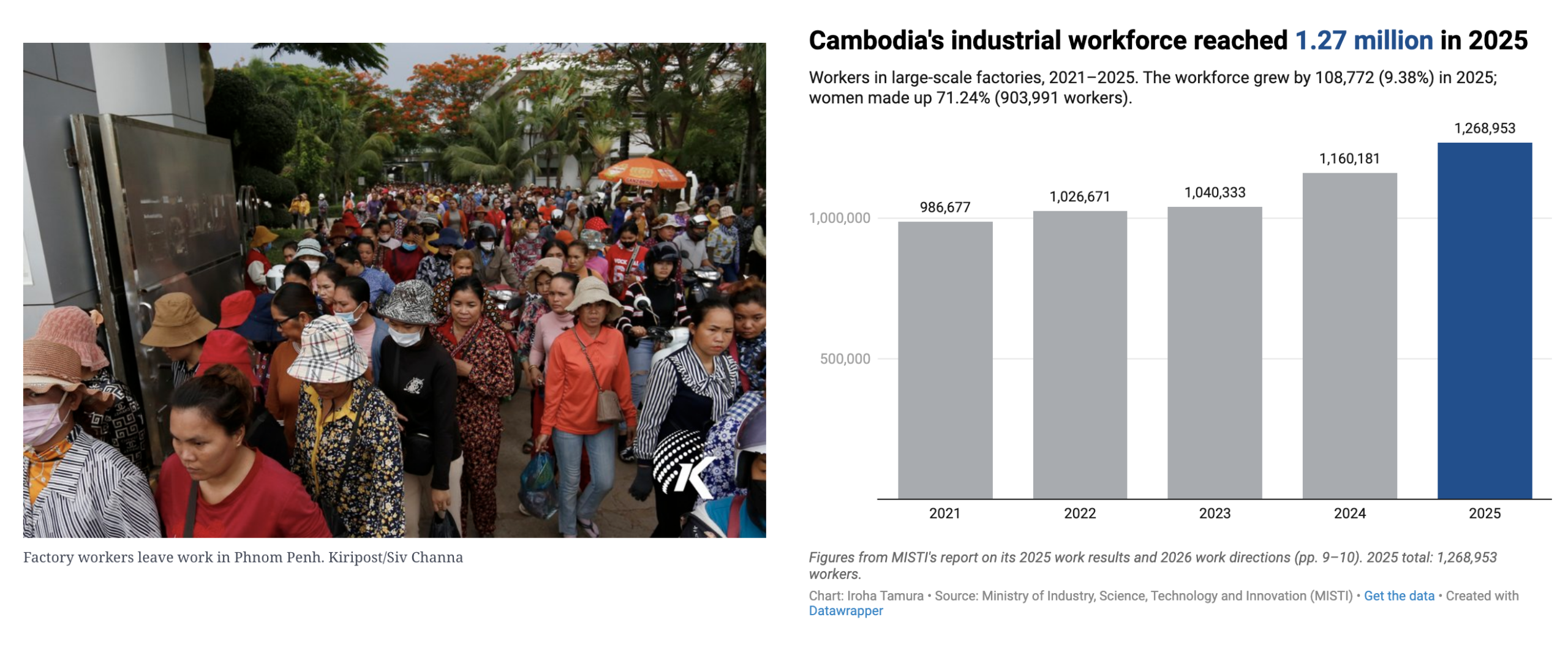
A total of 1,268,953 people were employed in the sector in 2025, including 903,991 women, who accounted for 71.24 percent of the total workforce. The workforce increased by 108,772 people, or 9.38 percent, compared with 2024.
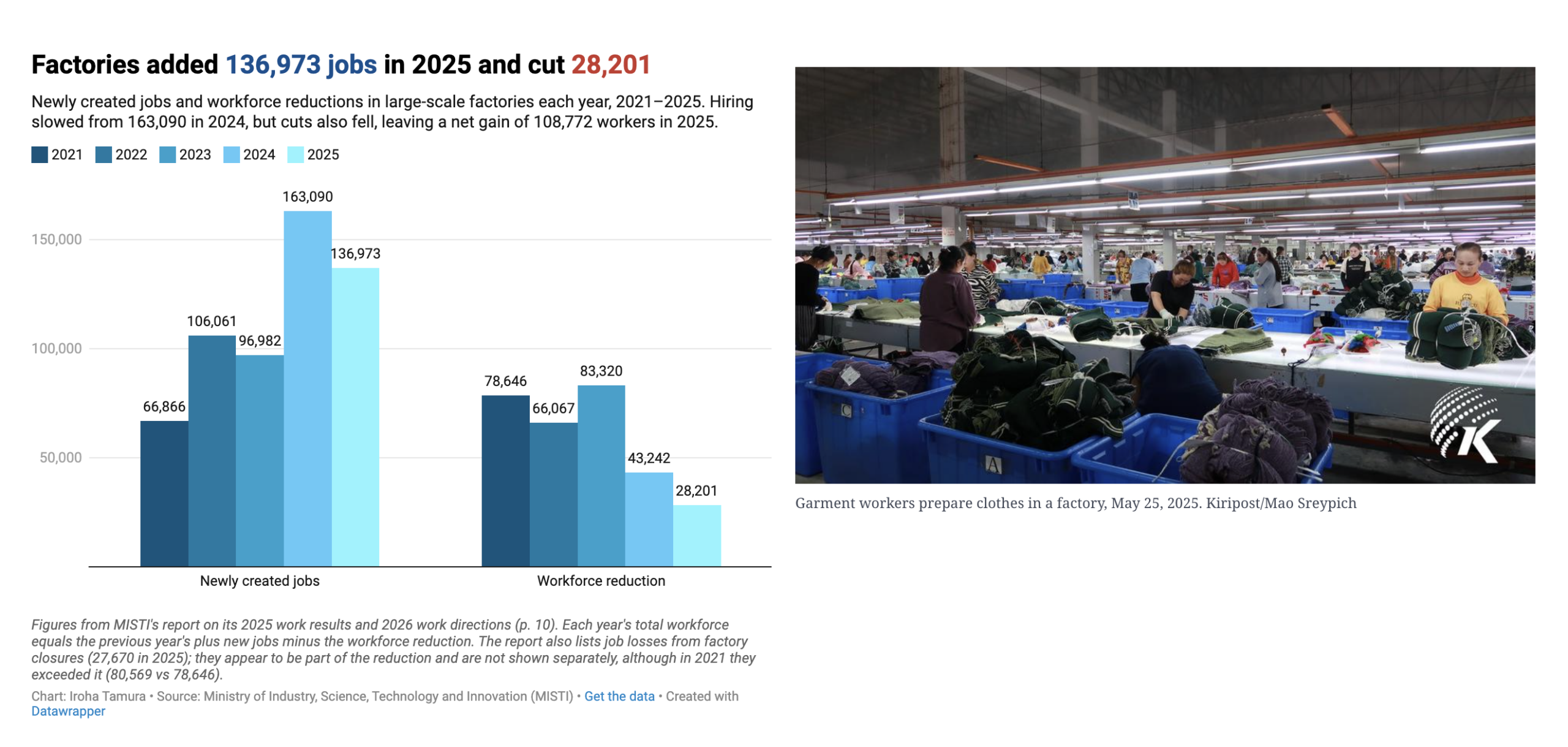
The ministry’s 2025 data also records annual changes in the industrial workforce, including increases in new workers and job losses resulting from factors such as factory closures.
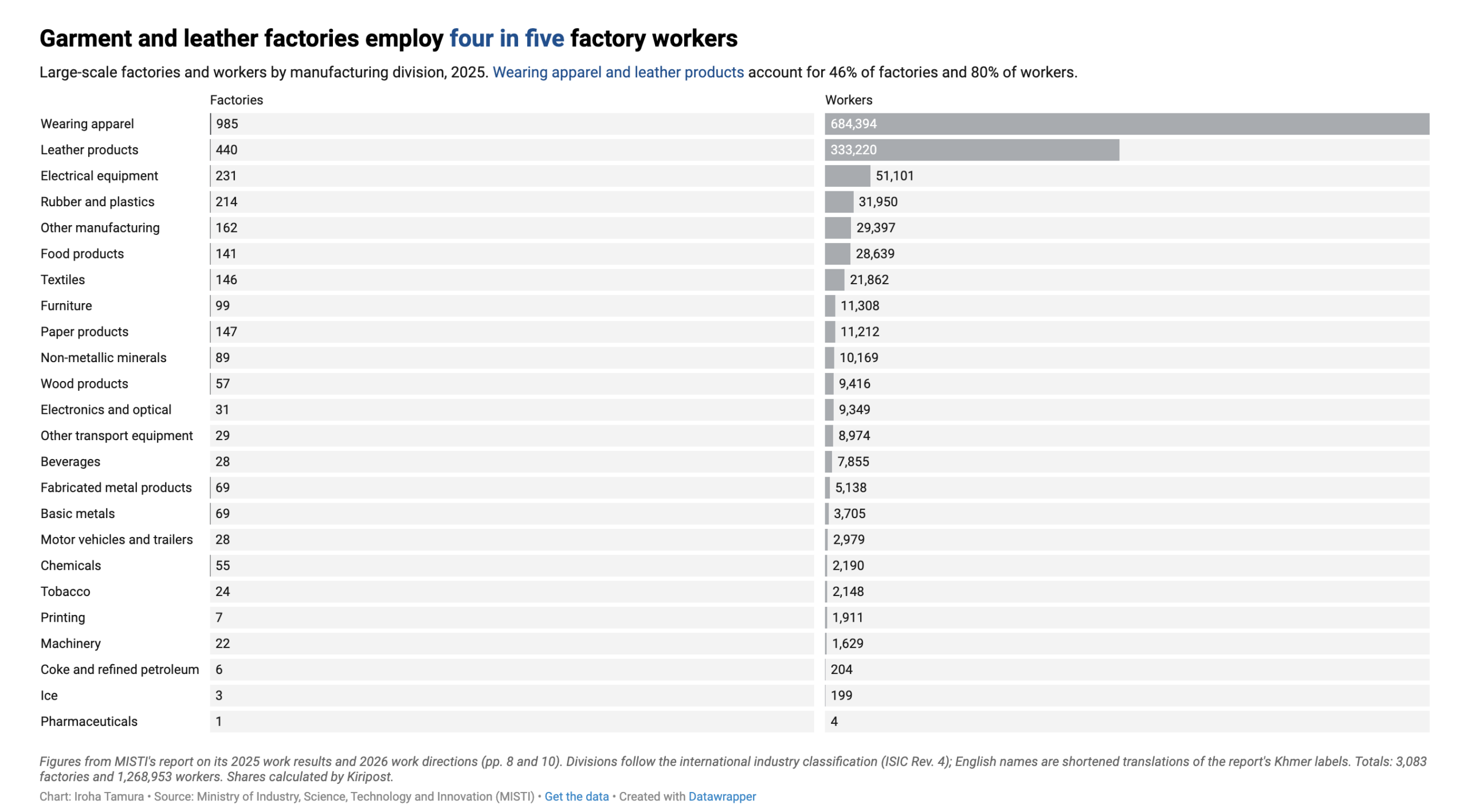
The report provides a breakdown of large-scale factories and workers across Cambodia’s 25 capital cities and provinces, as well as across 24 industrial sectors.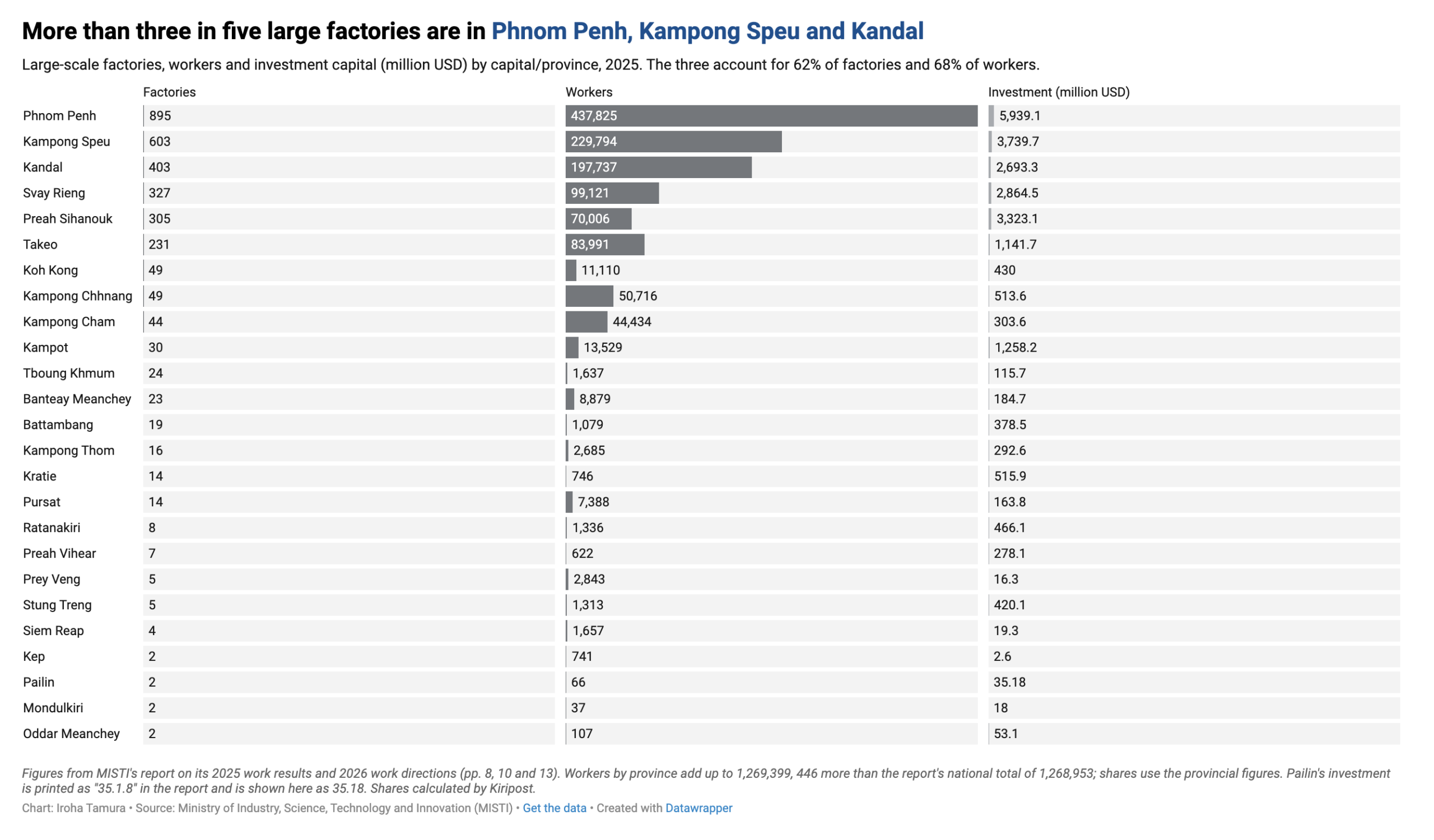
SEZs and industrial parks expand
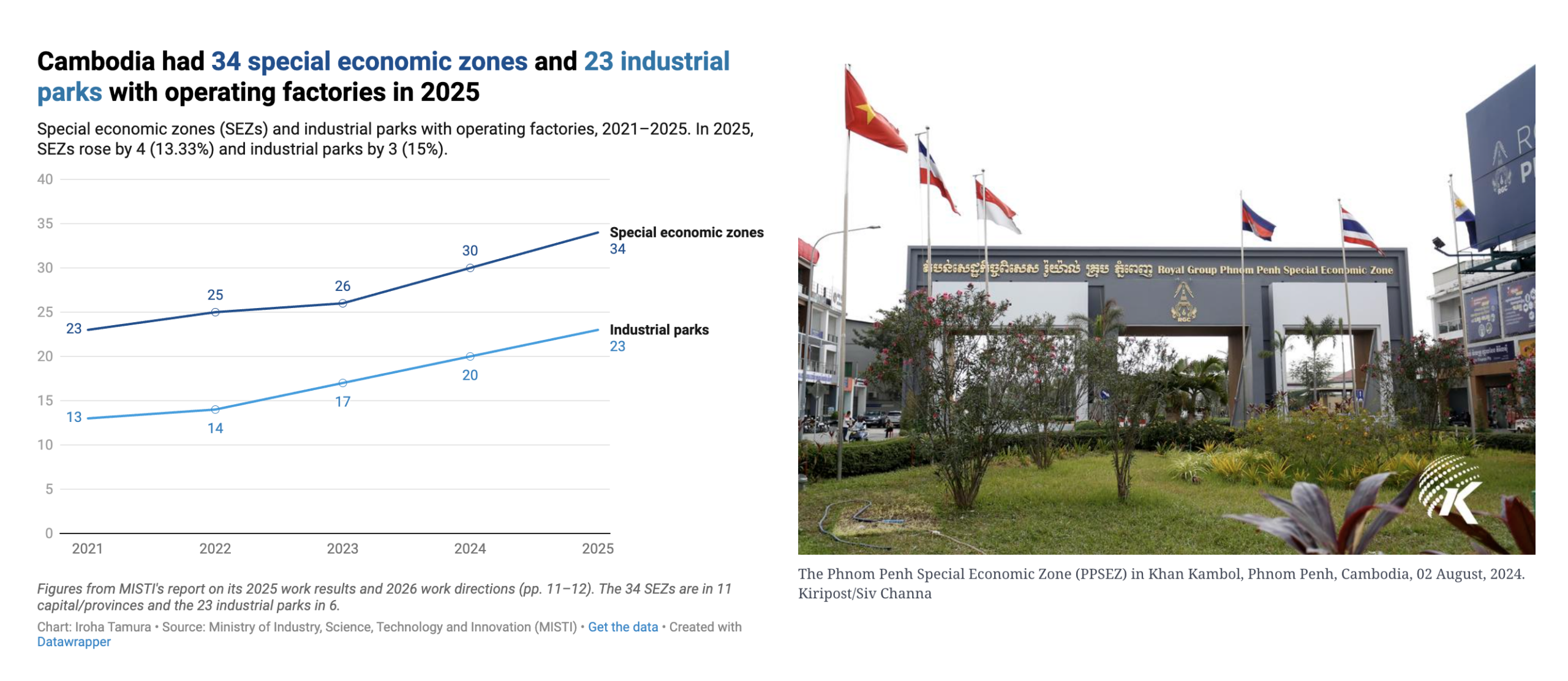
Cambodia had 34 special economic zones (SEZs) with operating factories in 2025, located across 11 capital-city and provincial areas. The number increased by four zones, or 13.33 percent, compared with 2024.
The country also had 23 industrial parks with operating factories across six capital-city and provincial areas, an increase of three parks, or 15 percent, compared with 2024.
Investment tops $25 billion
The ministry reported 32 sources of investment from domestic and foreign investors in 2025, unchanged from 2024.
Total investment capital exceeded $25.168 billion, an increase of more than $4.711 billion, or 23.03 percent, compared with 2024.
Domestic investment accounted for more than $3.906 billion, or 15.52 percent of total investment capital.
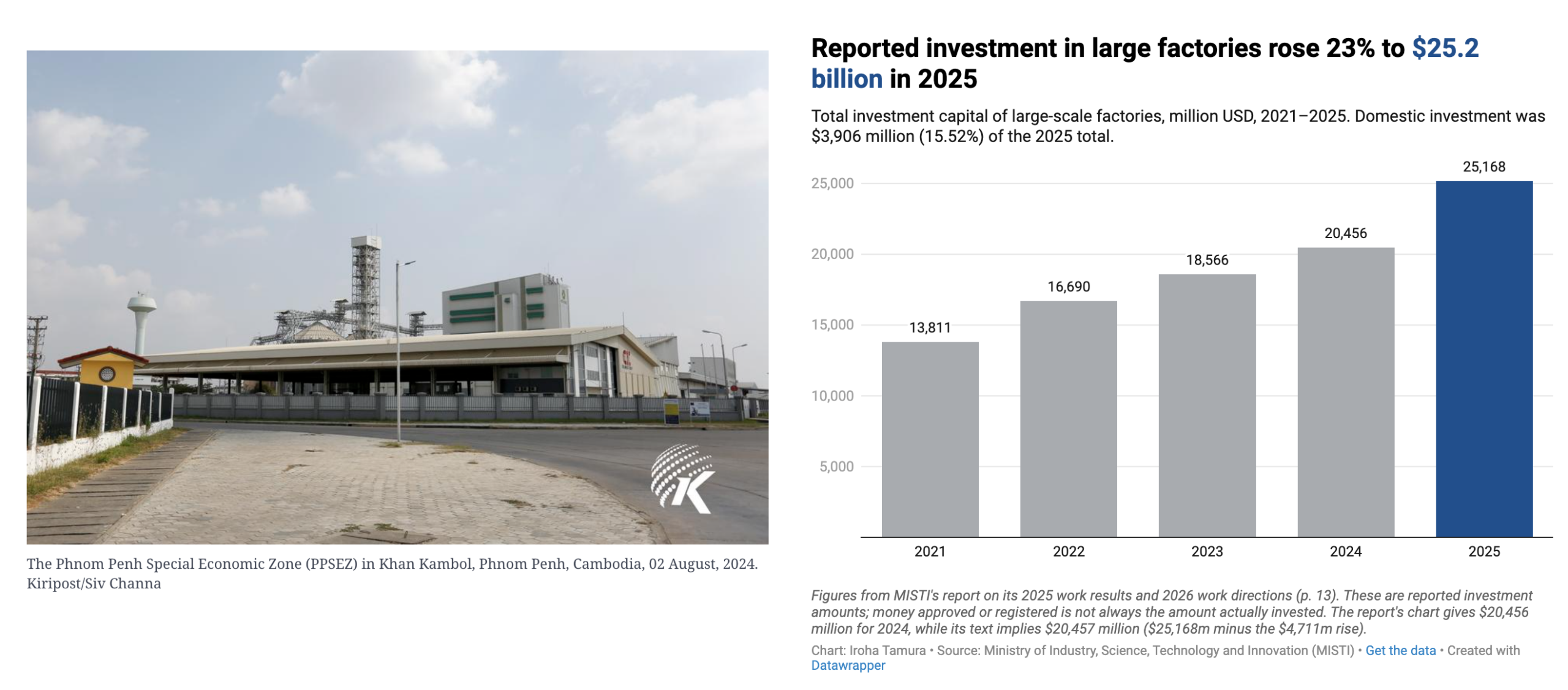
The ministry said the results demonstrated progress towards sustainable development in Cambodia’s industry, science, technology and innovation (STI) sector, with the sector becoming increasingly diverse while maintaining a focus on environmental and social responsibility.
It said the sector was also strengthening links between manufacturing and the agriculture, commerce and services sectors to promote economic integration, strengthen value chains and improve Cambodia’s competitiveness regionally and globally.
Focus shifts to Industry 4.0
MISTI said it was focusing on Industry 4.0 in response to global trends and in preparation for Cambodia’s digital economy.
The ministry aims to expand technology-related business markets, encourage research and innovation, and manage and reduce potential risks arising from technology, according to the report.
It is also focusing on entrepreneurship, micro, small and medium-sized enterprises (MSMEs) and the informal economy, with the aim of creating new decent jobs and opportunities while developing relevant legal frameworks and supporting regulations.
The ministry said the initiatives would also contribute to Cambodia’s preparations for its planned graduation from Least Developed Country (LDC) status at the end of 2029.
It added that it would continue strengthening its role as chair and coordinator of various government institutional mechanisms to support socio-economic development, strengthen the foundations of the national economy and sustain growth in an increasingly favourable business environment.
Another rate key to understanding impact of industrial growth
While Cambodia has recorded growth in the number of large-scale factories and industrial workers in recent years, Ryo Kawahara, Vice President of JBL Mekong, who is familiar with Cambodia’s economic trends, told Kiripost that “several other indicators should be read alongside the headline figures”.
“The first is the accuracy of the data itself. Before drawing conclusions, we should check how the figures are compiled. For example, whether a factory is counted when it is registered or when it actually starts operating, and whether closed or suspended factories are removed from the count,” he said.
“If these definitions are not consistent, the trend we see in the data may not reflect what is happening on the ground.”
Kawahara said factory and employment figures need to be assessed alongside other indicators, particularly the unemployment rate, which provides a clearer picture of how many people want to work but are unable to find jobs and earn an income.
“It is true that the data show an increase in the number of large-scale factories and workers in recent years. However, data alone does not tell us whether these factories are actually operating properly,” he added.
“Also, an increase in the number of workers does not necessarily mean that it directly affects people’s lives. To understand the relationship between changes in the workforce and people’s lives, we need to consider many different steps and factors.”
He said rather than focusing on any changes in the number of workers, the focus should be on any changes in the unemployment rate when considering the relationship between the data and people’s lives.
“This figure shows the number of people who want to work but are unable to find work and therefore cannot earn an income. In other words, to understand how these developments affect our daily lives, we need to carefully examine and compare the many different sets of data available.”
Investment figures should also be examined carefully, since the amounts reported when projects are approved are not always the amounts that are eventually invested, Kawahara noted.
“The investment value at the application or approval stage is a plan. What matters for the economy is how much of that capital is actually brought in and spent on buildings, machinery and hiring. Comparing approved investment with actual implemented investment gives a much more realistic picture of industrial growth.”
Kawahara said that wage levels are another key factor, noting that this is also an indicator of industrial growth.
“Even if the number of workers increases, the impact on livelihoods depends on how much they earn. It is useful to compare actual wages, not only the minimum wage, with the cost of living, and to look at how wages differ across sectors and compare with neighbouring countries. This tells us whether industrial growth is really raising household incomes,” he said.
“No single number can answer the question. Looking at employment, unemployment, investment actually carried out and wages together is the best way to understand how industrial development is changing people’s lives.”