



Southeast Asia Bucks Rising Youth Unemployment Trend
PHNOM PENH – Global youth unemployment climbed to 12. 4 percent in 2025, equivalent to 67 million unemployed people aged 15 to 24, a report by the International Labor Organization says.
The increase, driven by stagnant economic growth and weak job creation, marks a reversal from a two-decade low of 12.3 percent in 2023.
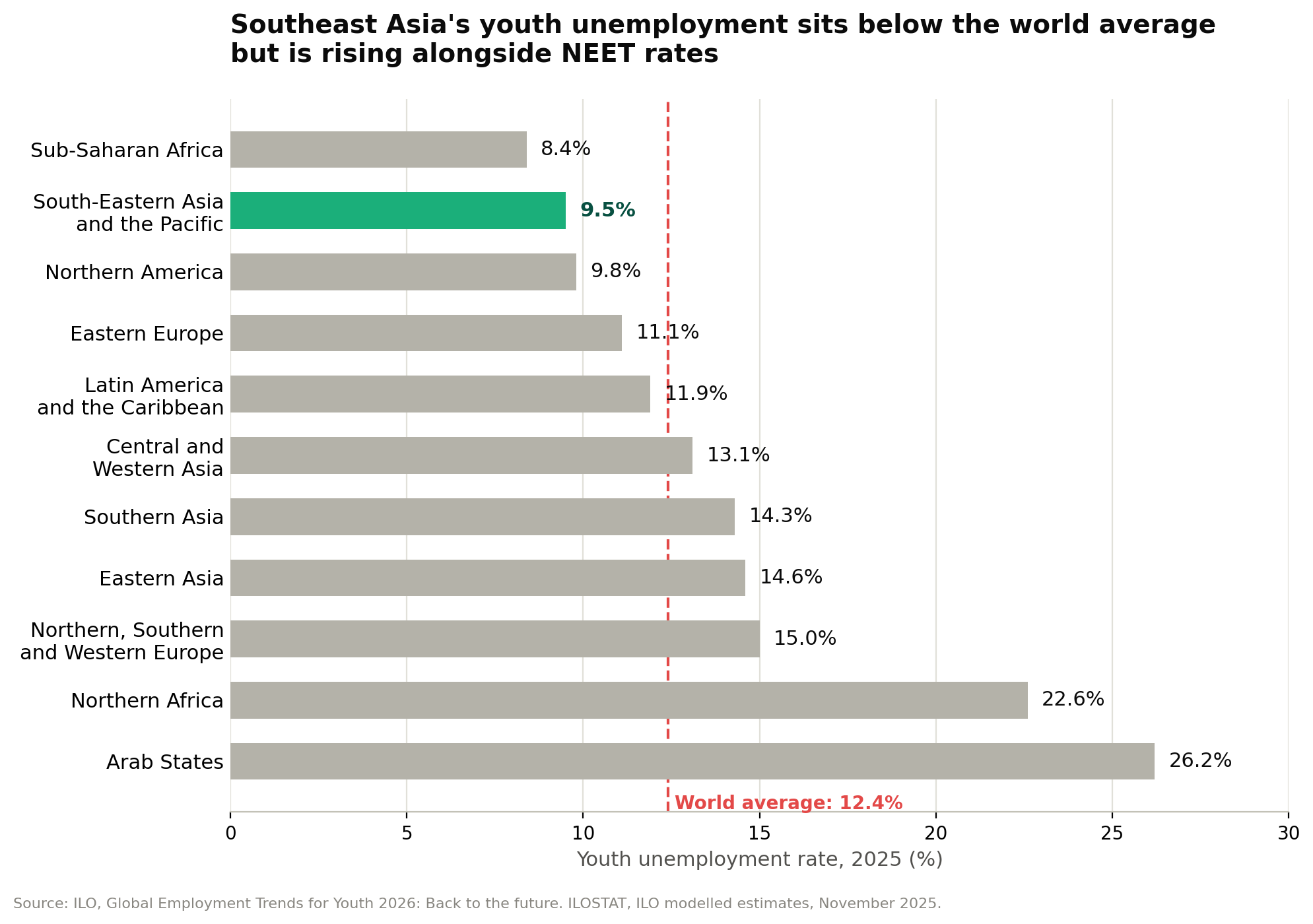
The South-Eastern Asia and Pacific subregion fared comparatively better, though its youth unemployment rate and the share of young people not working, studying, or training crept upward.
The report, titled Global Employment Trends for Youth 2026: Back to the Future, finds that between 2023 and 2025, youth unemployment rates increased in eight of the world’s 11 subregions, as slowing economic growth, weak job creation, geopolitical tensions and rapid technological change push countries toward a new youth jobs crisis.
Meanwhile, the share of young people not in employment, education or training (NEET) increased slightly to 20 percent, affecting more than 257 million people.
Some of the sharpest rises in youth unemployment have been in higher-income economies, frustrating the aspirations of millions of young people at the start of their working lives.
In a statement accompanying the report’s release, ILO director-general Gilbert F. Houngbo said young people who cannot find decent work will struggle to build their futures with confidence.
“When young people are locked out of quality employment, the emerging challenge is that countries lose talent, productivity and social cohesion,” Houngbo said.
That is why, he said, creating decent jobs for young people is not just a social imperative but one of the smartest investments a country can make.
AI Shapes Opportunities for Young
One interesting trend the report finds is the role of technological advancement, especially AI, in shaping the future job prospects of the young generation.
It estimates that 6.1 percent of jobs held by young people aged 15 to 29 are in occupations highly exposed to AI-related change.
The report also points to the growing importance of young people accessing skills that match evolving labor-market needs, corresponding to rising demand in knowledge-based technical occupations in fields like science, health and engineering.
Sukti Dasgupta, ILO director of the Employment, Skills and Sustainable Enterprises Department, wrote in the report’s preface that while the noise around AI is increasing, investment in technological and AI-related skills is more paramount than ever in the current context.
As the impacts of AI and technology remain ambiguous, she said countries need to ensure these changes work for young people, not against them, by boosting investment in skills, lifelong learning and social protection so that young people can adapt to change and seize new opportunities.
“While the evidence of its impact on jobs remains uncertain, we must not be complacent and underestimate the risks,” she wrote.
Southeast Asian Region
The report does not provide country-specific data on youth unemployment, only an overview by subregion.
The South-Eastern Asia and Pacific subregion had a youth unemployment rate of 9.5 percent in 2025, one of the lower rates globally.
Still, the subregion is grouped among those with both rising youth unemployment and rising NEET rates between 2023 and 2025, placing it in the same category as the Arab States, Eastern Asia, Northern Africa, Northern America and Sub-Saharan Africa, despite its comparatively low absolute rates.
The share of unemployed youth aged 20 to 29 who are first-time job entrants also rose modestly in the subregion, climbing from 44.3 percent around 2016 to 45.8 percent in the most recent period, meaning nearly half of unemployed young adults there have never held a job.
A Future with Youth Opportunities
The report offers several recommendations, centered on renewed action to help young people navigate an increasingly uncertain world of work.
It calls for countries to adopt a human-centered approach to AI governance, so that innovation creates opportunities rather than deepening inequalities.
The report also recommends building quality education, lifelong learning and apprenticeships, alongside improved employment services and stronger labor market institutions, to support young people’s transitions into work.
Countries can also invest in social protection, ensuring rights at work — particularly for young people in vulnerable situations.
“Creating more decent job opportunities through supportive macroeconomic and sectoral policies is also vital,” the report says.